Wednesday, 22 June 2016

Biology - EDEXCEL IGCSE - Reproduction and Inheritance

Reproduction and Inheritance

Asexual Reproduction is when a single parent copies its genetic information, forming a daughter which is genetically identical (clone) to itself. It involves no gametes and fertilisation.

Sexual Reproduction involves gametes which fuse to create a zygote and eventually an embryo which is not genetically identical to the parents.

Fertilisation involves the fusion of a male and female gamete to produce a zygote which then undergoes cell division and develops into an embryo.

Reproduction in Plants

Insect Pollinated Plant:

Wind Pollinated Plant:
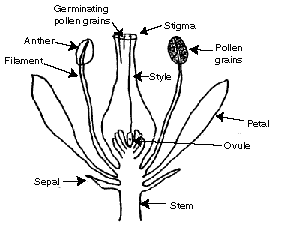
 
Adaptations of wind and insect pollinated plants:

Feature
Insect Pollinated
Wind pollinated
Stamen
Enclosed - to force insect to make contact
Exposed - so that wind can easily blow it away
Stigma
Enclosed - insect must make contact
Sticky - pollen sticks to it
Exposed - easier to catch pollen
Feathery - large surface area to catch pollen
Petals
Brightly coloured, large and scented to attract insects
Small and not scented or coloured as there is no need
Nectaries
Present so as to attract insect
No nectary
Pollen grains
Large, spiky and sticky to attract insects
Small, light, and aero-dynamic so that it can be easily carried bu the wind

Fertilisation:
1.    Pollination occurs where pollen is transferred from the anthers to the stigma. The stigma must be ripe so that chemicals can be produced for the production of pollen tubes and a sugary substance for energy.
2.    The pollen tube grows down through the style and into the ovary. It enters the ovule by the micropyle.
3.    The male nucleus moves out of the pollen grain and moves down the channel created by the pollen tube and ion the ovule.
4.    Fertilisation occurs where the male and female gamete fuse to form a zygote.
5.    The zygote undergoes mitosis in a seed to create an embryo.

Seed and fruit formation:
1.    The petals and anthers die as there is no longer any need for them.
2.    The ovule wall becomes the testa which protects the embryo.
3.    The cotyledon provides the food store for the embryo.
4.    The plumule is the embryonic shoot ad the radicle the embryonic roots.
5.    The ovary becomes the fruit.

Germination:
1.    The dormant seed is buried in soil.
2.    Water is absorbed by the seed through the micropyle.
3.    Food reserve (starch) in the cotyledon is mobilised.
4.    The testa splits as the seed expands.
5.    The radicle grows downwards. The root develops and begins to absorb water directly.
6.    The plumule begins to grow upwards with the cotyledon still fueling growth.
7.    The embryonic leaves of the plumule now clear of the ground and begin to photosynthesise.

Germination requires:
1.    Heat for enzymes to act efficiently.
2.    Water for chemical reactions to take place.
3.    Oxygen for respiration to release energy.
4.    Light is not needed.

Reproduction in Humans:


Male:
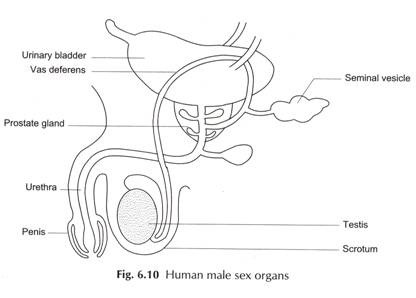
Sperm is stored and created in the testes. During intercourse it travels along the sperm duct in the penis and mixes with secreted liquid from the seminal vesicle to form semen. One ovum is released into the fallopian tube each month and when it is in the tube a sperm can fertilise it.

Female:


Menstruation:
Hormones are very important for this process. First the follicle stimulating hormone (FSH) stimulates the growth of the follicle containing an ovum. At the same time FSH stimulates the release of oestrogen which begins the re-thickening of the uterus lining and also slows the release of FSH and stimulates the release of LH (lutenising hormone). When LH is at its peak, ovulation occurs where the ovum is shed by the ovary. If sexual intercourse occurs, what is left of the follicle forms a structure called the corpus lute. This releases progesterone which completes the thickening of the uterus walls and inhibits production of FSH and LH, stopping any further ovulation. If the egg is not fertilised then the corpus lute breaks down and the lining of the uterus is shed through menstruation. Progesterone is also used during pregnancy to stop menstruation. It is produced by the placenta.

Placenta:
The placenta allows the embryo to obtain oxygen and nutrients and get rid of CO2 and excretionary waste (e.g. urea). The umbilical cord used to carry the blood containing the substances towards and away from the foetus. The placenta is also responsible for secreting progesterone in order to maintain a thick layer of endometrium in the uterus.

Amnion:
The amnion encloses the foetus and secretes amniotic fluid which protects the foetus from bumps while the woman is moving.

Secondary Sexual Characteristics:

Boys: controlled by testosterone
•   Growth of penis and testes.
•   Growth of facial and body hair.
•   Muscle development.
•   Breaking of the voice.

Girls: controlled by oestrogen
•   The breast develops.
•   Menstruation starts.
•   Growth of armpit and pubic hair.

Inheritance:

DNA or deoxyribonucleic acid contains two strands of alternating sugar and phosphate groups coiled to form a double helix. The strands are linked by two nitrogen bases at each "rung". There are four different bases: Adenine(A), Thymine(T), Cytosine(C), and Guanine(G). In DNA the bases are always paired. So if on one strand the base is A, the other must be T and likewise if on one strand it is C then on the other it must be G.


The nucleus of cells contains chromosomes on which genes are located. A gene is a section of a molecule of DNA which dictates a certain characteristic of the organism.

A certain genes can take different forms which although creates the same characteristic, doesn't create the same exact feature. For example, a gene may code for green eyes while the same gene might code for blue eyes. These different forms of the same gene are called alleles. Alleles give rise to differences in inherited characteristics.

Definitions:
•   Genes - a small section of DNA that determines a particular feature by instructing cells to produce a particular protein are called genes.
•   Alleles - an alternative form of a gene which gives rise to differences in inherited characteristics.
•   Dominant - a feature will always have two alleles. If one allele’s characteristic is present while the other is not then it is said to be dominant.
•   Recessive - if one allele is dominant then the other is said to be recessive.
•   Homozygous - contains two copies of one allele (e.g. TT, aa).
•   Heterozygous - contains two different alleles (e.g. Tt, Aa).
•   Genotype - describes the alleles each cell has for a certain feature.
•   Phenotype - a feature that results from the genotype.
•   Codominance - if two alleles are expressed in the same phenotype.
•   Diploid cells - cells with chromosomes in homologous pairs are said to be diploid. In humans the diploid number is 23 meaning each cell has 23 chromosomes.
•   Haploid cells - cells with chromosomes not in a homologous pair is said to be haploid. In humans the haploid number is 46.

The sex of a person is determined by a pair of chromosomes, XY in a male and XX in a female. The overall ratio of male and female births is 1:1

This can be shown by this diagram:


X
X
X
XX (female)
XX(female)
Y
XY(male)
XY(male)


Mitosis is the nuclear division of somatic (body) cells to create genetically identical cells which are used for growth, repair, asexual reproduction and replacing worn out cells.

Meiosis occurs to produce haploid cells that are used in sexual reproduction. It involves a similar process to mitosis except that there are two divisions compared to one in mitosis. Meiosis creates four cells, each with half the number of chromosomes and creates genetically different gametes.

A human male can produce millions of genetically different sperm cells and a female holds thousands of genetically different egg cells. This large pool of genetically different gametes and the fact that fertilisation is random allows genetic variation of the offspring. Not only is variation produced by genetics, it can also be produced through the environment.

A mutation is a rare, random change in genetic material which can be inherited. Many mutations are harmful but some are neutral and a few are beneficial.

Mutations that are beneficial can cause the mutant organism to increase in population through natural selection. An example of this is in bacteria that have mutated to be resistant to antibiotics. The variation in the species is that there are bacteria that are resistant and those that are not. The bacteria that are resistant live for longer and can therefore multiple more while the non-mutated species die out as they lack the advantage. This means they eventually populate the entire species.


The chances of mutations can be increased through mutagens. Examples of these are ionising radiation such as ultraviolet light, X-rays and gamma rays and many different chemicals, both natural and manmade (e.g. benzene).

Biology - EDEXCEL IGCSE - Excretion and Coordination

Excretion

The lungs, kidneys and skin are all organs of excretion.

Excretion: the removal of metabolic waste created in cells such as urea, carbon dioxide and water. The lungs, kidneys and skin are all organs of excretion.


Renal/Urinary system:
 
Function:
The urinary system is used to create, store and remove urine which in turn removes wastes such as urea. Blood flows to the kidneys which separates it into the components of urine: water, urea, some salts. The urine them moves down the ureters and is stored in the bladder until the two sphincter muscles relax where it then exits the body.

The components and various concentrations of urine may vary depending on the amount of water and salt intake and whether you have kidney failure or diabetes.

Kidneys: the kidney is involved in both excretion and osmoregulation.


Nephron: there are millions of these in each kidney and they are the main areas of the kidney where filtration occurs.


Ultrafiltration is the separation of smaller molecules such as glucose, water, urea, oxygen, salts, and amino acids from the blood at the glomerulus in high pressure.

Selective reabsorption is where molecules in the glomerular substrate are retaken by the capillaries at the proximal convoluted tubule. It is selective as only some molecules such as glucose, amino acids and some salts are retaken.

Water is reabsorbed into the blood both through selective reabsorption and through osmosis at the collecting ducts. The latter is controlled by ADH (anti-diuretic hormone). When the hypothalamus detects the blood is too concentrated, it tells the pituitary gland to release ADH which travels via the blood stream to the kidneys. ADH makes the collecting ducts more permeable to water meaning more water is absorbed. This is how the kidneys act in osmoregulation.

Finally, after ultrafiltration and selective reabsorbing has occurred, the remaining substances arrive at the collecting ducts where it travels down the ureter to the bladder excreted. The excreted urine contains water, urea and salts.

Coordination and Response:

Organisms are able to respond to a change in their environment (stimuli).

A coordinated response requires a stimulus, a receptor and an effector.

Coordination in plants:

Plants respond to stimuli. Stimuli which acts in a particular orientation are known as directional stimuli. A tropism is a plant growth response caused by a directional stimulus.

Roots are positively geotropic meaning they grow in the same direction as gravity. Auxin, a plant growth substance is produced behind the root tip and diffuses to the lower side of the growth region. This inhibits growth or elongation of the underside. The top side, however, elongates faster, causing the roots to grow downwards.

Shoots are negatively geotropic. Auxin produced behind the shoot tip diffuses to the lower side of the growth region. This causes more rapid elongation and division of cells on the lower side. This causes the shoots to grow upwards.

Note that at the roots auxin inhibits growth while at the shoots auxin encourages it.

Shoots are also positively phototropic. In unidirectional light auxin diffuses from behind the shoot tip to the growth region and accumulates on the shaded side. Cells then divide and elongate on the side causing the shoot to bend towards the light.

In uniform light, auxin diffuses from behind the shoot too to the growth region and distributes evenly. This causes the shoot to grow upwards towards the light.

Coordination in Humans:

Comparison of nervous and endocrine system:
•    Both move instructions around the body and participate in homeostasis.
•    Neurons use electrical impulses while hormones use chemicals.
•    Neurons target specific collection of cells while hormones target specific cells.
•    Hormones are relatively slow while neurons are very fast and rapid.
•    Hormonal effects are relatively long lasting while neurons only create a short effect.

Neurons:

Sensory neuron

Motor neuron
Relay neurone

Central Nervous System: This contains the brain and spinal cord and is what gives out orders to other parts of the body.

How neurons work:
An electrical impulse is sent from a nerve receptor and travels along the axon. At the nerve ending, there is a gap (synapse). A synapse works as the electrical impulse triggers the release of neurotransmitters. These chemicals diffuse across the synaptic cleft and binds with receptors on the second neurone. This forms a neurotransmitter-receptor complex which stimulates the second neurone to transmit the electrical impulse. The unused neurotransmitters are then either reabsorbed or broken down by enzymes.

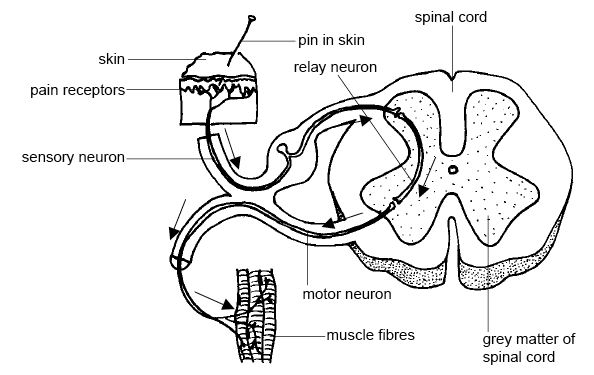
Spinal cord: the spinal cord marks the site of coordination where information sent from sensory neurones are passed via relay neurones to motor neurones for the impulses to be sent to effectors.


Reflex Arc:
1.    Receptor cells detect stimulus
2.    Receptor stimulated and an electrical impulse sent along sensory neurons to the central nervous system (CNS).
3.    At the CNS it travels along synapses to the relay neurone.
4.    The relay neurone passes it to the motor neurone.
5.    The impulse travels via the motor neurone to the target muscle or gland effector.
6.    This creates an effect.

Examples of this are the knee jerk reflex and the withdrawal reflex. Both of these are spinal reflexes and so are involuntary. This is because you only receive information (to your brain) after the reflex has occurred due to the speed. In fact, the knee jerk reflex can take just 50ms.

The Eye:

Function:
The eye is a photoreceptor (detects changes in light) and transduces light energy into electrical impulses. These are then interpreted as images by the brain. The eye is also able to respond to changes in light and is able to focus and bend light reflected of objects to allow the brain to produce a discernible image.


Focusing near and distant objects:
If an object is near, ciliary muscle will contract which relaxes the suspensory ligaments so that the lens becomes fat and slightly curved (convex). If the object is far, ciliary muscle will relax, making the suspensory ligaments tighten so that the lens stretches out and becomes thin and flat.

Responding to changes in light intensity:
In dim light, the iris dilates the pupil to allow more light to reach the retina. It does this by contracting the radial muscles and relaxing the longitudinal muscles. In bright light, the iris will shrink the pupil.

Skin:


Function:
1.    Protection
2.    Waterproof barrier
3.    Thermoregulation

Thermoregulation:
1.    Sweat glands release sweat when the internal temperature is too high. The evaporation of sweat uses heat energy of the skin. This takes away heat energy.
2.    Vasodilation occurs when the body is too warm. The shunt vessel constricts and the capillaries widen meaning more blood flows through the surface of the skin and so more heat is lost through the radiation of heat. Vasoconstriction occurs when you are too cold. The opposite occurs meaning less heat is lost through radiation.
3.    Hair erector muscles relax to flatten the hair when it is warm. This means less trapped air is present and therefore there is less insulation. The opposite occurs when it is cold.
4.    Adrenaline is used to raise metabolism meaning more energy is released and so more heat is also released.
5.    Shivering - more respiration occurs in muscles meaning more heat is released.

Hormones:

Pituitary:
•   Anti-Diuretic Hormones (ADH) - involved in osmoregulation by controlling the permeability of collecting ducts.
•   Gonadotrophin - controls the production of sperm and ovulation and triggers sexual maturation.

Adrenal:
•   Adrenaline - prepared the body for the "fight or flight" response in times of stress. It increases heart rate, raises blood pressure, enlarges pupil size, and raises the body's metabolism.

Thyroid gland:
•   Thyroxine - controls the body's metabolic rate.

Pancreas:
•   Insulin - helps control the body's blood sugar level by signaling the liver, muscle and fat cells to take in glucose and convert it to glycogen.
•   Glucagon - helps control the body's blood sugar level by telling the liver to convert stored glycogen into glucose which is then released into the blood stream.


Hormones are vitally important for growth and development. The main hormones involved are the pituitary growth hormone, thyroid hormone and sex hormones.

Biology - EDEXCEL IGCSE - Transport

Transport:

Diffusion is heavily involved in gaseous exchange. It is the method where by most gases move.

Single, unicellular organisms can rely on diffusion for movement of substances into and out of cells. This is because they are relatively small and so can rely on diffusion compared to larger multicellular organisms, which are so large that to only rely on diffusion would mean substances will be delivered around the organism very slowly.

Because of this, multicellular organisms must also have a transport system which allows for a more efficient method of movement of substances.

Transport in plants:

Osmosis - the movement of water molecules from a high water potential to a low water potential through a semi-permeable membrane.

A lack of osmosis will cause the vacuole and cytoplasm of the plant cells to shrink. The cell membrane may separate from the cell wall (plasmolysed). The cells become flaccid and the plant wilts.

A lot of osmosis will cause the vacuole and cytoplasm of the plant cells to expand. The cell membrane will push against the cell wall. The cells become turgid, supporting the plant. Lysis may also occur where the cell bursts.

Water absorption in roots:

Osmosis occurs to bring water from the soil where there is a high water potential and to the root hair cells which have a lower water potential. This occurs through a semi permeable membrane. However, soil particles are too big to pass through meaning only water is up-taken. Osmosis occurs through the entire root, going through the epidermis, cortex, endodermis until it reaches the xylem where water is carried up through transpiration.

Xylem:
•    Used to transport water and minerals towards the plant (one way).
•    A hollow tube of dead cells.
•    Contains lignin which makes the tube waterproof, allowing it to transport water.

Phloem:
•    Used to transport sugars and amino acids (two ways).
•    Contains sieve cells and tubes for mass movement.
•    Does not contain a nucleus so need companion cells to supply it with genetic information.

The xylem and phloem join together to form a vascular bundle. In the roots there is one massive vascular bundle called a stele. In the stem there are smaller vascular bundles.

Transpiration is the evaporation of water in aerial parts. A transpiration stream is the movement of water through the xylem through transpiration.
1.    Water between the palisade and spongy cells evaporate due to the heat from sunlight.
1.    This creates a vacuum, meaning water rises in the xylem.
2.    Water vapour diffuses into spongy cells and is used in photosynthesis.
3.    Unused water vapour diffuses out via the stomata.

Transpiration is needed for:
•    Transporting water for photosynthesis.
•    For cells to remain turgid.
•    To transport minerals.
•    To act as a rolling mechanism.

Factors affecting transpiration:

1.    More heat = More energy = Faster evaporation = More transpiration
2.    Higher humidity = More water molecules in air = Gentler concentration gradient = Less transpiration
3.    Higher wind speed = Water molecules are distributed = Steeper concentration gradient = More transpiration
4.    More sun = More heat = Stomata opens = Allows more water vapour to leave the leaf = More transpiration

Using a petometre you can determine the rate if transpiration

Weight petometre: when a plant transpires it loses water so it loses weight. Therefore, if you have a plant with no other way of losing weight other than transpiration (layer of soil, plastic bag), on a scale you can measure the rate of change and therefore the rate of transpiration.

Volume petometre: a bubble of gas is allowed to flow up a tube with a plant shoot. The rate at which it transpires up the then is measured and shows the rate if transpiration.

Minerals are taken up by plants, however, most of the time the concentration gradient is too low so diffusion cannot occur. Therefore, active transport is used. This uses chemical energy and carrier proteins to take in mineral salts.

A deficiency in minerals salts can cause diseases:


Nitrates
Potassium Ions
Phosphate ions
Magnesium
Uses
DNA
Enzymes
Cell membrane
Chlorophyll

Amino acids


Deficiency
Stunted growth
Yellow leaves
Poor root growth
Yellow leaves
Symptoms
Older leaves turn yellow
Dead spots
Young leaves turn purple


Transport in Humans:

The Blood Contains…
•   Plasma
•   Red blood cells (erythrocytes)
•   White blood cells (lymphocytes and phagocytes)
•   Platelets

Plasma:
Plasma is involved in the transport of carbon dioxide, digested food, urea, hormones and heat energy. Many substances are dissolved in plasma such as mineral salts.

Red Blood Cells:

Adaptation
Explanation
Contains haemoglobin
Used to combine with oxygen to form oxyhaemoglobin. This allows oxygen to be transported.
No nucleus
Leaves more space fir haemoglobin so that more oxygen can be transported.
Biconcave shape
Allows for a more efficient exchange of oxygen in and out of cells by increasing surface area.
Thin
Short diffusion pathway increases the rate of diffusion.
Flexible
This allows it to squeeze through blood capillaries.


The Antibody/Antigen reaction:
1.    Lymphocytes recognise individual marker chemicals called antigens on the surface of the pathogens.
2.    Lymphocytes’ receptor proteins bind with the antigens.
3.    When it binds the lymphocytes divide rapidly, producing millions of the same type of lymphocyte that is capable of recognising the microorganism.
4.    Most of this occurs with B and T lymphocytes.
5.    Most B-lymphocytes begin to produce antibodies which bind with the antigens, causing the pathogens to clump together. This makes it easier for phagocytes to ingest it through phagocytosis where pseudopodia enclose the pathogen. Some antibodies also cause the pathogens to burst apart. Some also develop into memory cells which remain for a long time and if the cells re-infect, the memory cells will start to reproduce and produce antibodies. Because of this the secondary immune response is much faster than the primary.
6.    T-lymphocytes destroy our own cells. These cells have become infected with a virus or are cancerous. This is done through releasing chemicals that “punch a hole” in the cell or activates a “programmed cell death” that is put into the genetic coding of every cell. Some also become memory cells like B-lymphocytes.

Vaccines:
These are a form of an artificial active immunity and works by injecting a person with an “agent” that carries the same antigens as a specific disease causing microorganism. This works by artificially creating an antigen/antibody reaction. This can be achieved by injecting…
•   An attenuated (weakened) strain of the actual microorganism (e.g. polio, TB and measles)
•   Dead microorganisms (e.g. whooping cough, typhoid)
•   A modified toxin of the bacteria (e.g. tetanus)
•   Just the antigen (e.g. Influenza)
•   Harmless bacteria, genetically engineered to carry the antigen of a different disease carrying microorganism.

Platelets:
Exposure to air stimulates the platelets and damaged tissue to produce chemicals. This causes the soluble protein fibrinogen to change into an insoluble fibre of a protein called fibrin. Fibrin forms a network across the wound, trapping the red blood cells and forming a clot. This prevents further loss of blood and entry of pathogens. The clot will develop into a scab which protects the damaged tissue while the new skin grows.

Heart:
 

How the heart works:
1.    Blood enters the atria.
2.    The walls of the atria contract, raising pressure and forcing open the bicuspid and tricuspid valves.
3.    When the ventricles fill with blood, the ventricles contract, raising pressure and closing the valves.
4.    The ventricles continue to contract and raise pressure. This forces the semilunar valves (pulmonary valve and aortic valve) to open.
5.    Blood flows into the aorta which carries blood to parts of the body and the pulmonary artery which carries blood to the lungs.
6.    High pressure in the aorta and pulmonary artery closes the semilunar valves and the process restarts.

Heart attacks are caused when the coronary artery is blocked completely meaning the heart muscles will stop contracting. This blockage is usually caused by a buildup of fat called an atheroma. Many factors can make heart attacks more likely:
1.    Heredity
2.    Permanent high blood pressure/hypertension puts more strain on the heart muscles as it has to work harder to pump blood.
3.    Diet - a diet rich in fats raises cholesterol. High cholesterol and fats creates the atheroma which can block the coronary arteries.
4.    Smoking - nicotine constricts blood vessels, raises blood pressure, speeds up the heart rate and increases blood cholesterol.
5.    Stress - hormones released during stress constricts blood vessels, raising blood pressure.
6.    Lack of exercise - regular exercise reduces blood pressure and strengthens the heart.

Heart rate:
Your heart rate increases during exercise to supply oxygen needed for the increased need for aerobic respiration to release more energy to be supplied to the muscle. This occurs as the aorta and the carotid artery detects extra carbon dioxide from the exercise and sends a signal to the medulla in the brain. The medulla sends impulses along the acceleration nerve. When carbon dioxide production slows, the medulla sends impulses along the decelerator nerve.

Arteries:
1.    Used to carry food away from the heart.
2.    Small lumen (central cavity).
3.    Thick wall with thick muscle fibres and elastic tissue.

Vein:
1.    Used to carry blood to the heart.
2.    Large lumen (central cavity).
3.    Thin wall with little muscle fibres and elastic tissue.
4.    Have valves which prevents the back-flow of blood.

Capillaries:
1.    Carry blood through organs and between cells.
2.    Capillary walls are one cell thick and allow substances to diffuse in or out.

Circulation System: